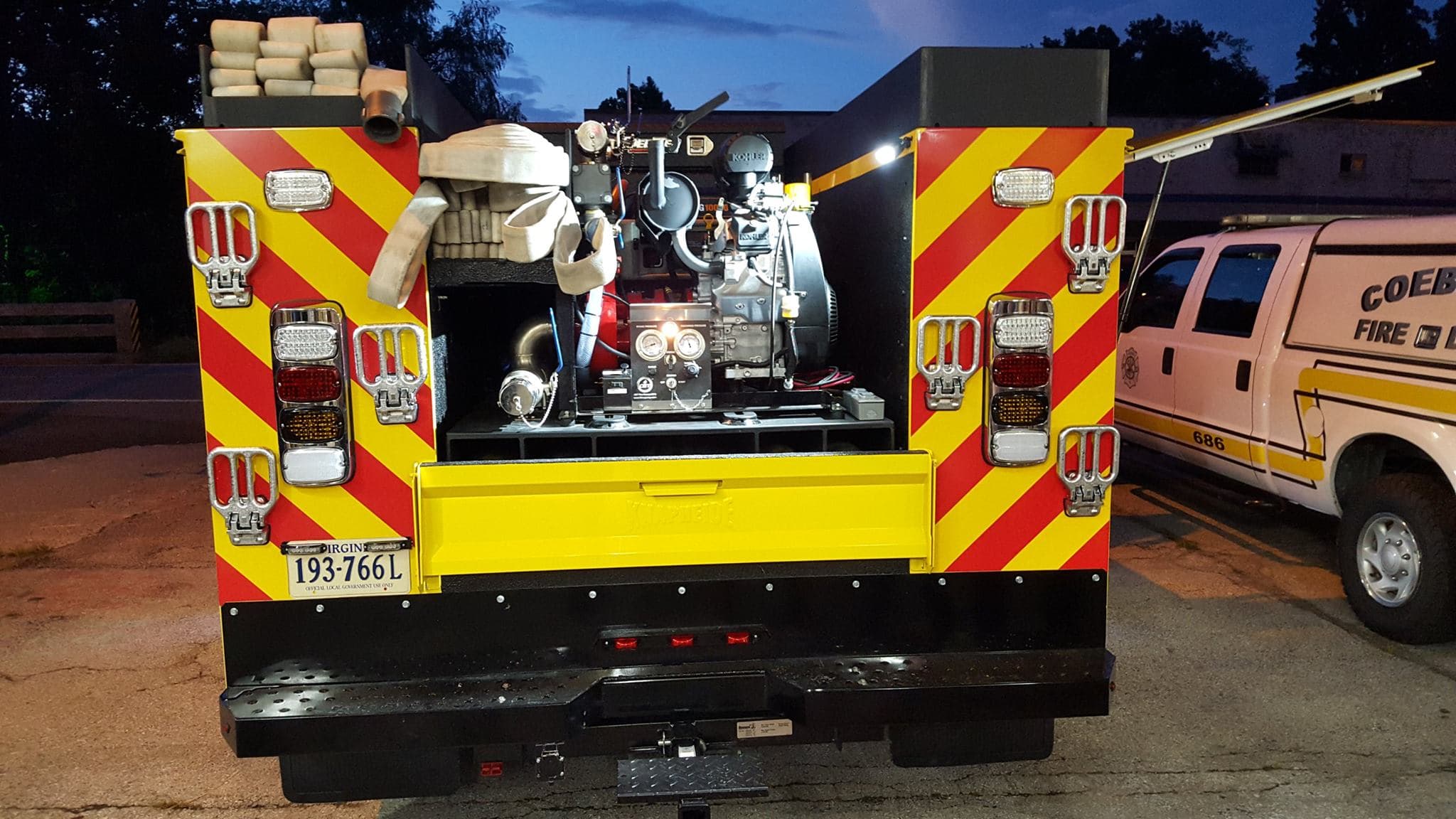
Mission
Brush and field fires, wildland-urban interface, standby at a working structure fire, water supply on a tanker shuttle. Every line item after this one is justified by it.
Built & serviced in Lemoyne, PA — by firefighters, since 2009
Blue Mountain skid units · Built in Lemoyne, PA
Let us custom build your next skid unit for the way you operate with everything you need and nothing you don't.
Quoted per build
Tank, pump package, plumbing and valves, hose reel, frame and mounting, controls, and the storage you asked for — priced as one build. Specific capacities, component models, and dimensions are confirmed on the proposal for your truck rather than assumed from a catalog page.
Bring the exact chassis: year, make, model, bed or body dimensions, and the manufacturer's current GVWR, front and rear axle ratings, and payload. Water alone runs about 8.34 pounds per gallon, so the loaded total gets checked against those ratings before anything is cut.
Eastern Fire Equipment Services can handle your entire skid unit project from start to finish, out of the shop at 440 Oak Street, Lemoyne, PA 17043. Questions about a build, a part, or an existing unit go to (800) 504-2044.
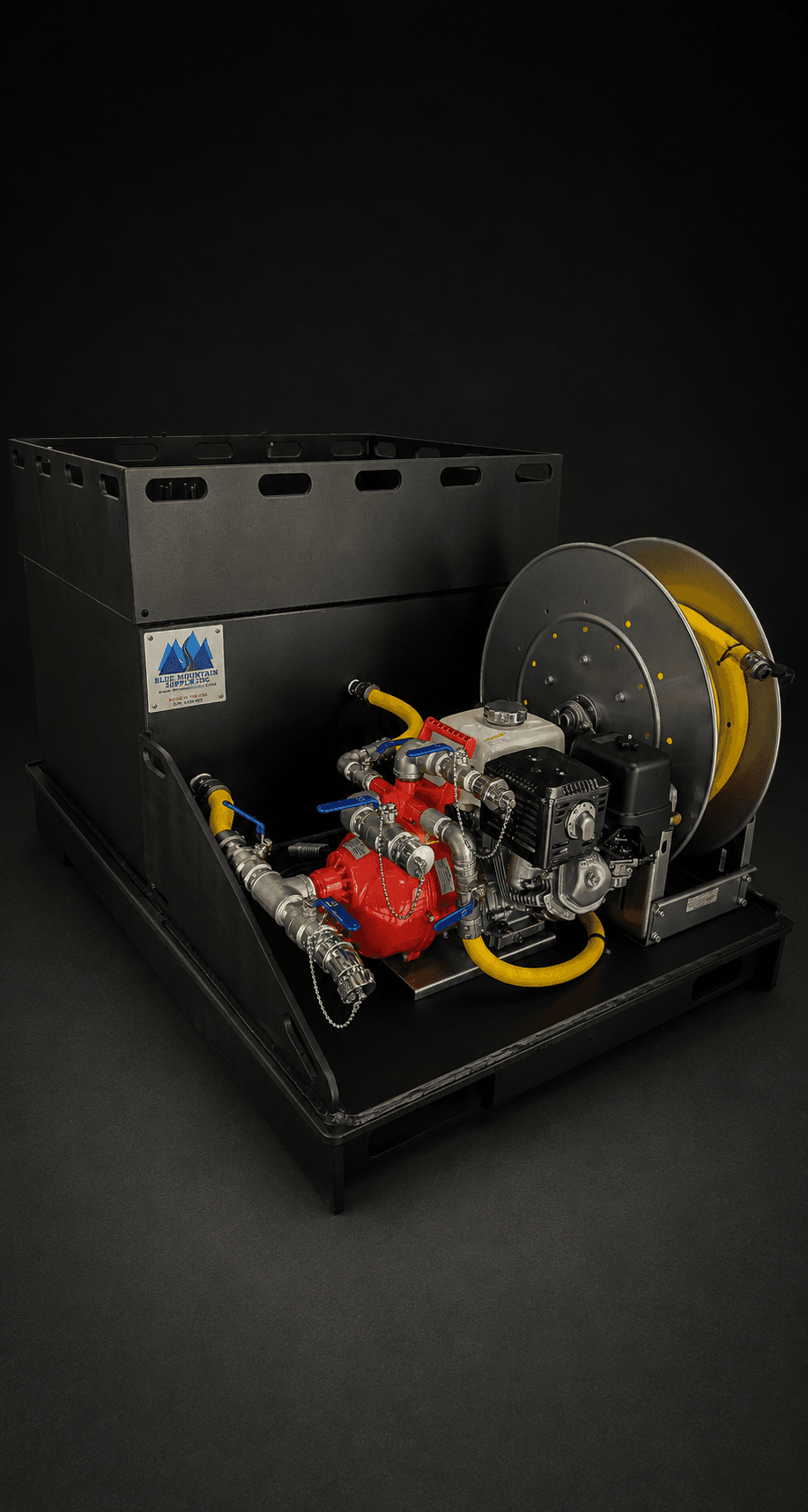
Product overview
A brush truck skid unit is a self-contained water tank, engine-driven fire pump, plumbing, hose reel, and controls on one frame that drops into a pickup bed, flatbed, or utility body. It turns a truck your department already owns into a brush and wildland attack unit without buying purpose-built apparatus.
Eastern Fire Equipment Services can handle your entire skid unit project from start to finish. We are proud builders of the Blue Mountain Skid Unit, using top-quality components — pumps from Hale Products and CET Fire Pumps, reels from Hannay, forestry hose from Mercedes Textiles. Every unit is built at 440 Oak Street in Lemoyne, Pennsylvania, and leaves the bench with a Blue Mountain nameplate, a serial number, and a Made in the USA stamp.
Still deciding what kind of unit you need? Start with the firefighting skid units overview, or look at the UTV and medical builds that come off the same bench.
The build sheet
A quote is only as good as the information behind it. Settle these five and the first meeting goes straight to configuration instead of twenty minutes of clarifying questions.
Brush and field fires, wildland-urban interface, standby at a working structure fire, water supply on a tanker shuttle. Every line item after this one is justified by it.
Year, make, model, bed or body dimensions, plus the manufacturer's current GVWR, axle ratings, and payload for that exact truck. Water runs about 8.34 pounds per gallon, so 150 gallons is roughly 1,251 pounds before the tank, frame, pump, hose, tools, or crew.
Gallons buy operating time and spend payload, in that order. Brush skids across the broader market commonly land between 100 and 300 gallons; size yours against a verified load budget and your refill plan, not against the largest tank that clears the wheel wells.
Say what the line has to do at the nozzle, then work backward through hose diameter, length, and elevation. Compare pumps on the manufacturer's curve at that point — maximum flow and maximum pressure are published at different places on the same curve.
Diameter and length on the drum, manual crank or powered rewind, which side the operator works from, and where the tools, fittings, and adapters ride. A reel positioned for the photograph instead of the firefighter is the most common regret on a finished skid.
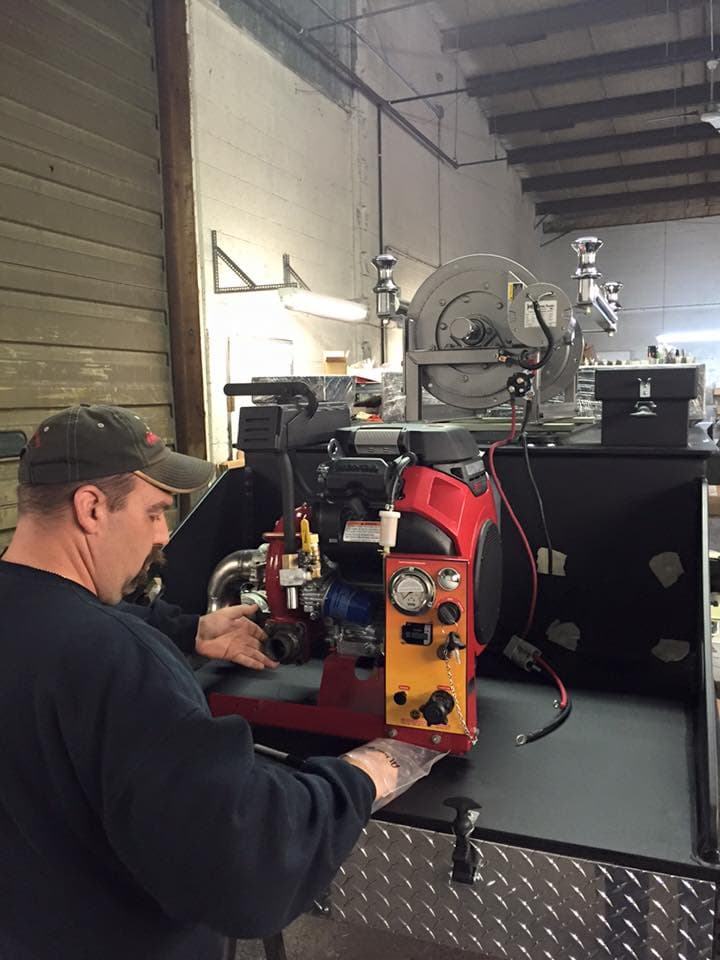
Removable skid or dedicated brush body is worth settling early too. A skid keeps the chassis available for other work and can move to a replacement truck later; a purpose-built body packages storage tighter and keeps the tank lower. Either way, the mounting and the loaded weight belong on the approval drawing before anything is cut.
Before you pick a tank size
NWCG typing baseline
Plenty of departments start a brush-truck project because a mutual-aid agreement or a grant references a Type 6 engine. These are the current minimums from the NWCG engine-typing table published in the 2026 Interagency Standards for Fire and Fire Aviation Operations. They apply to the whole apparatus: a skid supplies the water and pumping side, but the finished, staffed, loaded truck is what gets typed.
Swipe to compare
| Minimum criterion | Type 6 minimum | What it puts on the skid |
|---|---|---|
| Tank capacity | 150 gal | About 1,251 lb of water before tank, frame, pump, hose, tools, or crew. |
| Pump flow | 50 GPM | Flow the pump holds at the rated pressure below, not a best-case figure. |
| Rated pressure | 100 PSI | Confirm the manufacturer's curve at 50 GPM and 100 PSI together. |
| 1.5-inch hose | 300 ft | Tray or bed space, and the weight that comes with it. |
| 1-inch hose | 300 ft | Usually the working line. Reel drum size follows it. |
| Pump and roll | Required | Water delivered while the truck moves. Designed and verified on the finished truck. |
| Maximum GVWR | 19,500 lb | A ceiling on the complete loaded vehicle, chassis and body included. |
| Minimum personnel | 2 | Staffing rather than equipment, but it shapes the cab, seats, and PPE aboard. |
Before you request a quote
Start with the mission and the verified payload, not a catalog maximum. Water runs about 8.34 pounds per gallon, so 150 gallons is roughly 1,251 pounds and 300 gallons is roughly 2,502 pounds before any hardware, crew, or tools. Work the load budget first and let capacity fall out of it — the method is on firefighting skid unit pumps, tanks, and specs.
Not by itself. A skid supplies the tank, pump, plumbing, hose, and reel a Type 6 project needs, but resource typing describes the complete, staffed, loaded apparatus. Your department still verifies hose complement, pump-and-roll, staffing, loaded weight, and axle ratings on the finished truck. Full breakdown: Type 6 brush trucks and wildland skid units.
It means the apparatus can deliver water while moving, so a crew can walk a line alongside a truck creeping up a fire road instead of stopping to flow. It appears in the NWCG Type 6 typing table, so departments targeting that classification have to plan and verify it. Apparatus get there two ways: a pump driven off the chassis through a power take-off, or a pump with its own engine running independent of the drivetrain — the arrangement a skid unit uses.
Some builds do. The South Central Fire District unit in the gallery above carries a separate foam fill alongside its water fill. Class A foam is the wildland class, and systems generally proportion it around the pump through an eductor or by direct injection from a metering pump. Whether a foam cell fits your payload is a build decision, not a standard feature of every Blue Mountain skid — put it on the build sheet and EFES will confirm it against your configuration.
Both follow the configuration, so neither is published here. Tank capacity, pump package, plumbing, reel and hose, controls, mounting, storage, and installation all move the number, and chassis or body work moves it further. Request a quote or call (800) 504-2044 and the proposal comes back against your actual build, with current timing.
Blue Mountain skid units · Lemoyne, PA
Bring the mission, the chassis, and the equipment list your committee has already argued about.
EFES turns them into a configuration you can review, question, and approve before anything is cut.
Request a quote, book a build meeting, or call (800) 504-2044.